At a glance
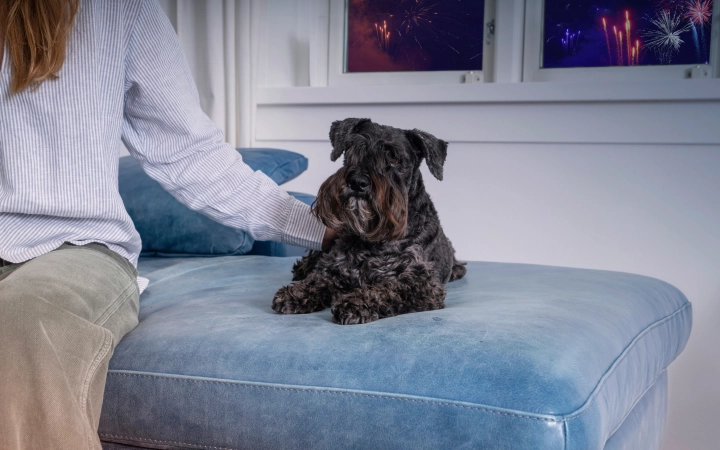
- Dog fireworks anxiety can range from mild unease to severe distress caused by sudden, unpredictable bangs and flashes.
- Preparing early with a familiar safe space, secure home and adjusted routine can help your dog cope.
- During fireworks, keep your dog indoors, stay calmly nearby and offer reassurance if they seek it.
- Pheromone products and complementary feeds may provide additional support alongside practical changes at home.
- Speak to your vet if your dog’s fireworks fear is severe, worsening or putting them at risk of injury.
Bonfire Night can be a lot of fun, especially for children. But it’s also a time of the year that can be really stressful for dogs. Loud, unpredictable bangs and flashes can trigger anything from mild unease to severe distress.
Lots of dog owners have a real problem with fireworks. But you can still make a real difference for your pet at this time, whether you’re preparing months ahead or fireworks are only a few days away. The key is knowing what to do at each stage.
This guide explains the signs of dog fireworks anxiety, what you can do before and during fireworks and when it’s best to speak to your vet.
Why are dogs scared of fireworks?
Fireworks combine sudden loud noises with unpredictable timing and bright flashes. Your dog can’t understand what the bang is, when the next one’s coming or that it doesn’t pose an immediate threat.
Some dogs aren’t bothered. Others get really scared. Others are somewhere in the middle.
The PDSA reports that 41% of dog owners say their dog is afraid of fireworks, showing just how common the problem can be. And repeated exposure doesn’t necessarily mean a dog will simply get used to loud noises.
Fireworks can also contribute to wider stress in dogs, particularly if your dog is already sensitive to changes or loud noises.
What are the signs of fireworks anxiety in dogs?
Dogs show fear in different ways. Some signs are obvious, while others are easy to miss.
Common signs of fireworks anxiety
You may notice your dog:
- trembling or shaking
- panting when they aren’t hot
- pacing or struggling to settle
- hiding or cowering
- barking or whining
- staying unusually close to you
- refusing food or treats
- toileting indoors
Subtle signs to look for
Less obvious signs can include:
- repeated lip licking
- yawning despite not being tired
- keeping their tail tucked
- lowering their body posture
- constantly scanning the room
- freezing briefly
- reacting differently from their normal behaviour
Signs your dog may need more support
Repeated escape attempts, frantic destructive behaviour or an inability to settle suggest a higher level of distress.
If your dog risks hurting themselves, stays severely distressed after the fireworks stop or suddenly develops a much stronger reaction than usual, make sure you contact your vet.
Looking after your dog’s healthcare is always important, but especially so when there’s a heightened risk of stress.
How to prepare your dog for fireworks with a Bonfire Night timeline
The right approach depends on how much time you have.
Long-term training needs months. Changes to your home and routine can still help much closer to Bonfire Night. Some calming aids also need to be introduced in advance, if you choose to use them.
Several months before: start long-term fireworks training
If your dog has struggled badly with fireworks before, don’t wait until November to make a plan. Speak to your vet well ahead of the next fireworks season.
This is also the best time to begin gradual sound desensitisation.
You may want to:
- Play recorded firework sounds at a very low volume your dog can comfortably tolerate.
- Pair the sound with something positive, such as food or play.
- Increase the volume very gradually once your dog is comfortable with the sound of fireworks.
- Reduce the sound or stop if your dog shows any signs of stress.
The Blue Cross recommends allowing around four to six months for fireworks sound training and advises progressing at your dog’s pace rather than trying to meet a deadline.
If your dog’s fear is severe, get as much expert advice as you can and ask your vet about support from a suitably qualified behaviour professional.
Is October too late to desensitise a dog for Bonfire Night?
For a dog that already fears fireworks, October is generally too late to rush a full desensitisation programme before Bonfire Night.
That doesn’t mean you’ve left it too late to help. At this stage, focus on preparing your home and routine, introducing appropriate support and contacting your vet if your dog has a history of significant fear.
Two to four weeks before: prepare your home and make a plan
Start making your dog’s environment as predictable and secure as possible.
Check local display dates and, where practical, ask neighbours whether they’re planning fireworks. Make sure gates, fencing, windows and doors are secure and check that your dog’s microchip details are up to date.
Create a safe space your dog can choose to use. This could be a familiar corner, an under-stairs space or a quiet central room with no windows if you have one. Even if it’s a bathroom.
Add familiar bedding and keep access open. If your dog uses a crate, that can form part of their safe space, but don’t suddenly shut them into an unfamiliar crate on Bonfire Night.
This is also a natural point to consider calming support for dogs alongside the environmental changes you’re already making.
One to two weeks before: introduce support that needs time
Calming products can be useful alongside a secure environment, familiar routine and your support. They shouldn’t replace those foundations.
ZENIDOG Gel Diffuser
Our ZENIDOG Gel Diffuser uses a synthetic version of canine appeasing pheromones dogs naturally recognise. These scentless chemical signals are only detectable by dogs and can help create a more reassuring environment during stressful situations such as fireworks.
The pheromone analogue is designed to mimic the comforting signals associated with nursing, which can help some dogs feel more settled when faced with unfamiliar or stressful triggers.
Improvement may be seen within one week, while each diffuser covers up to 70m² and lasts for up to two months. Place it upright in an area where your dog spends plenty of time, such as close to their usual resting or safe space.
ZENIDOG Collar
Our ZENIDOG Collar provides continuous pheromone support that stays with your dog as they move around. Rather than working in one room, the collar releases a canine appeasing pheromone analogue close to your dog throughout the day.
When worn continuously, it’s designed to help reduce your dog’s response to familiar stress triggers such as fireworks. Improvement may be seen within seven days and the collar lasts for up to three months. Remove it for bathing or swimming.
ANXITANE
ANXITANE is a complementary feed containing L-theanine from green tea concentrate. It’s designed to support calm and relaxation without causing drowsiness.
L-theanine can also support focus and learning, which can be helpful when calming support is used alongside positive behavioural training.
ANXITANE comes as a fish-flavoured tablet, and we recommend starting it two weeks before predictable stressful events like fireworks.
How to keep your dog calm during fireworks
Once fireworks start, focus on how your dog is coping rather than continually changing their environment.
Keep them indoors and let them choose where they feel safest. Stay with them where possible, offer a chew, toy or food if they’re interested and allow them to hide if they want to.
It might sound obvious, but don’t punish fearful behaviour, force your dog to interact or drag them out of a hiding place.
Should I comfort my dog during fireworks?
Yes. If your dog comes to you for reassurance, of course you can comfort them calmly. Reassuring a frightened dog isn’t going to reward or reinforce their fear. Stay calm and respond to what your dog is asking for.
If they want to sit close to you, let them. If they’d rather stay in their den, give them space. Remember your dog doesn’t understand what’s happening. They’re likely to be confused, stressed, and in need of some love and support.
Can my dog go outside while fireworks are going off?
Avoid normal walks while fireworks are active.
If your dog needs an essential toilet break, wait for a lull if you can. Keep them on a secure lead or harness, stay with them and get back inside as soon as you can.
Don’t assume an enclosed garden is completely safe. A sudden bang can frighten any of us, and cause even a normally settled dog to bolt or try to escape.
What can I give my dog for fireworks anxiety?
Pheromone products and complementary feeds may help some dogs, while longer-term behavioural work can change their response to noise over time. Dogs with severe fear may need veterinary assessment and prescription treatment.
Different calming options do different jobs, so it’s more useful to choose support based on your dog’s needs than to treat every product as interchangeable.
You can check out our range of dog calming products if you’re considering supportive options alongside environmental management.
When should I speak to my vet about fireworks anxiety?
Speak to your vet if your dog:
- shows severe or worsening panic
- repeatedly tries to escape
- becomes destructive in a way that risks injury
- can’t settle for a prolonged period
- remains highly anxious despite sensible home management
- persistently refuses food or water
- stays distressed well after the fireworks stop
- suddenly develops noise sensitivity
- becomes noticeably more fearful with age
If your dog was severely distressed last year, speak to your vet before the next fireworks season rather than waiting for the first bangs.
An injury, collapse or other acute medical emergency needs urgent veterinary attention.
Why has my older dog suddenly become scared of fireworks?
New or worsening noise sensitivity in an older dog is worth discussing with your vet because health problems can sometimes contribute.
A small University of Lincoln study found that dogs with musculoskeletal pain tended to develop noise sensitivity later and show broader reactions to sounds than dogs without identified pain. It doesn’t prove that pain causes fireworks fear, but it’s worth checking for possible medical factors.
What should you do after the fireworks stop?
Don’t assume everything is over as soon as an organised display ends. Private fireworks can continue later into the evening.
Wait for a genuinely quiet period before taking your dog outside. If they’re still unsettled, keep them on a lead.
Let them leave their safe space in their own time, make sure fresh water is available and return to your usual routine calmly.
It’s also worth noting what seemed to help and what triggered the strongest reaction. That information can make next year’s plan much more effective.
Bonfire Night is only part of the UK fireworks season. Diwali often falls around this time, including on 8 November in 2026, while fireworks are also popular on New Year’s Eve.
Helping your dog through Bonfire Night
Fireworks fear isn’t misbehaviour. Your dog is responding to something they find threatening and the best approach is to be calm and practical, and to plan around their needs.
Start as early as you can, make your home feel secure and let your dog choose whether they want reassurance or space. Calming products may provide useful additional support, while significant fear deserves veterinary advice.
Explore our dog calming range to find supportive options that can fit alongside your plan for Bonfire Night.
FAQs about dogs and fireworks
What makes fireworks frightening for dogs?
Fireworks are loud, sudden and unpredictable. Bright flashes can add to the experience and your dog can’t understand when the next bang is coming or that it isn’t an immediate threat.
What’s the best way to calm a dog during fireworks?
Keep your dog indoors, make their prepared safe space available and stay calmly nearby. Comfort them if they seek reassurance or let them hide if they prefer.
Should I stay with my dog on Bonfire Night?
If you know your dog is frightened by fireworks, stay with them where possible. You don’t need to interact constantly. Being calmly available when they need you can be really reassuring.
Is it OK to comfort a dog that’s scared of fireworks?
Yes, if they want comfort. You don’t need to ignore a frightened dog because you’re worried about reinforcing fear. Offer calm reassurance but respect their choice if they’d rather hide.
What can I safely give my dog for fireworks anxiety?
Pheromone products and complementary feeds may help some dogs as part of a wider plan. There’s no guaranteed over-the-counter solution and severe fireworks fear may need veterinary assessment and prescription treatment.
Can I start fireworks desensitisation in October?
For a dog that already fears fireworks, October is generally too late to rush a full desensitisation programme for 5 November. Focus on safety and management now, then begin gradual sound work during a quieter period.
Should I let my dog outside during fireworks?
Avoid normal walks. If your dog needs the toilet, wait for a quiet spell, keep them securely on lead and stay with them until you return indoors.
When should I start calming support before Bonfire Night?
It depends on the type of support. Behavioural work needs months. You may see improvement with ZENIDOG within seven days, while you should ideally start your dog with ANXITANE two weeks before a stressful event.
Can fireworks fear get worse over time?
Yes. Some dogs become less sensitive over time while others become more fearful. If your dog’s reaction gets worse each year, plan earlier for the next season and speak to your vet if their fear is a worry.
Our Canine Calming Range
-
309361_Packshot_Zenidog_Gel-Diffuser-x1_face.png 
309361_Packshot_Zenidog_Gel-Diffuser-x1_back.png -
308303_Bag_Veggiedent-Zen_XS_face.png Family-packshot_Veggiedent-Zen.jpg VeggieDent® ZEN Dental Chews – Calming Treats for Dogs
Extra small dog - Small dog - Medium dog - Large dog
From £8.25Details -
309359_Packshot_Zenidog_Collar-S-x1_face.png Family-packshot_Zenidog-Collars.jpg