
At a glance
- Dog dental chews can work, but the best products help reduce new plaque and tartar build-up as part of a daily routine.
- Learn how to choose the right dental chew based on your dog's size, chewing style, safety and the evidence behind the product.
- Find out why brushing is still the gold standard, and how dental chews can support your dog's oral health between brushing sessions.
- Discover what makes products like VeggieDent different from ordinary treats and rawhide chews, and why design and formulation matter.
- Know when home dental care isn't enough, so you can recognise the signs that it's time to speak to your vet.
If you’re trying to look after your dog’s teeth and oral hygiene, dental chews can seem like an easy answer. But do dog dental chews really work, and can they help with your dog’s dental care?
The answer is a qualified yes. Well-designed, evidence-supported dental chews can help reduce new plaque and tartar build-up. However, results vary between products, and chews shouldn’t replace toothbrushing or regular veterinary dental checks.
This guide explains how dental chews for dogs work, what to look for and how they can fit into your dog’s wider oral hygiene routine.
Do dental chews work for dogs?
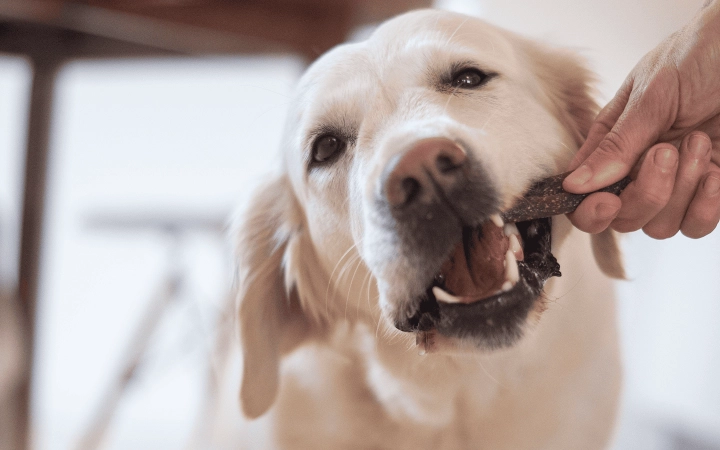
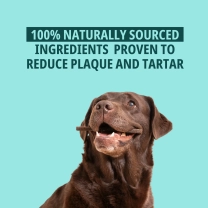
Some dog dental chews can help reduce the accumulation of new plaque and tartar when they’re used consistently and as directed. Their effectiveness depends on the product, including its shape, texture, size and the expertise that’s gone into creating it.
Plaque is the soft bacterial film that forms on your dog’s teeth each day. If it isn’t regularly removed, it can mineralise and become tartar (also known as calculus). Tartar is harder and can’t usually be removed by a dental chew or ordinary brushing once it’s firmly attached.
Dental chews can help to:
- reduce new plaque accumulation
- slow tartar build-up
- support fresher breath
- add another useful step to your dog’s daily dental care
They can’t remove significant existing tartar, clean beneath the gumline or treat gum disease. If your dog already has sore gums, loose teeth or advanced dental disease, they’ll need veterinary assessment rather than homecare alone.
Dental chews work best as one part of your dental care routine, alongside brushing and professional advice.
How do dog dental chews clean teeth?
Most effective dog chews for teeth rely mainly on physical cleaning. Some also contain ingredients that support breath freshness or oral cleanliness.
Mechanical abrasion
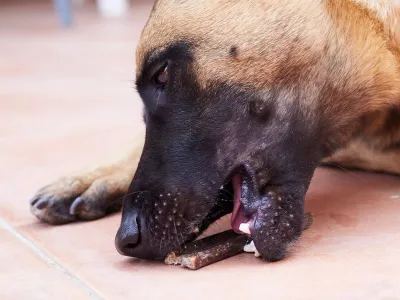
What we call mechanical abrasion is when the chew rubs against the tooth surface as your dog bites and chews. The amount of contact is key, which brings in the importance of good product design.
Key things include:
- shape
- size
- texture
- chewing resistance
- chewing time
- contact across multiple tooth surfaces
A chew that’s swallowed after one or two bites is unlikely to provide the same cleaning action as one your dog chews thoroughly.
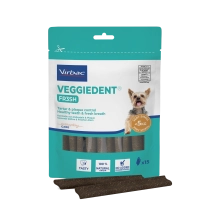
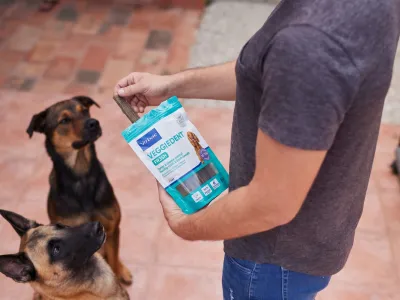
At Virbac, our VeggieDent FR3SH dental chews have a distinctive Z-shape and resilient texture designed to encourage chewing and improve contact with the teeth, including harder-to-reach surfaces. This mechanical action can help reduce plaque and tartar accumulation as part of your pet’s daily care.
Enzymatic action and other active ingredients
Some oral care products use enzymes or other ingredients to support bacterial control or fresh breath. However, an enzymatic claim doesn’t automatically make one product more effective than another. It’s the evidence behind the product that counts.
Our VeggieDent FR3SH chews have our FR3SH technology with pomegranate, erythritol and prebiotic inulin. These ingredients support breath freshness through complementary oral and digestive mechanisms.
This is different to our enzymatic toothpaste, which combines brushing with Virbac’s Dual Enzyme System. We’ll explain that in more detail below.
What’s the difference between dental chews and rawhide?
Rawhide is a type of chew material. A dental chew is a product designed specifically to support oral hygiene.
Purpose-designed dental chews are shaped and textured to increase contact with the teeth as your dog chews. Chews like ours have scientific backing that they can help reduce plaque or tartar accumulation.
Rawhide chews are usually intended mainly for recreational chewing. Their shape, texture, digestibility and dental benefit can vary widely between products.
This doesn’t mean every rawhide chew is unsuitable, or that every dental chew is effective. The most important things are whether the product is the right size for your dog, safe for how they behave and chew, and supported by credible evidence.
The fact that rawhide is made from animal hide can also be a consideration, while some dental chews use alternative formulations. For example, our VeggieDent chews are plant-based and contain no animal protein.
How to choose the right dental chew for your dog
The best dental chews for dogs in the UK aren’t simply the most popular ones. The right choice should suit your dog’s mouth, chewing behaviour, diet and health needs.
Choose the correct size
Follow the manufacturer’s weight or size guide. Your dog might gulp down a chew that’s too small too quickly, or find it hard to deal with one that’s too big.
VeggieDent FR3SH is available in four sizes, helping you choose an option that’s appropriate for your dog’s body weight.
Consider safety and chewing style
Supervise your dog when you introduce a new chew, especially if they tend to gulp or bite very forcefully.
You should also:
- remove small leftover pieces where appropriate
- avoid chews that are too hard for your dog’s teeth
- watch for coughing, distress or repeated swallowing attempts
- seek veterinary advice immediately in the event of choking, persistent vomiting or suspected blockage
Very hard products may increase the risk of tooth fracture, particularly in aggressive chewers.
Check ingredient quality and dietary suitability
Check the product’s calories, allergens and digestibility. You should also consider whether it’s appropriate for your dog if they’re on a prescribed diet or have a medical condition.
Dental chews count towards your pet’s daily calorie intake, so include them when considering how they fit in with the rest of your dog’s diet.
And remember that terms such as natural, plant-based or grain-free don’t prove that a chew will improve dental health on their own. Look for evidence relating to the finished product.
Look for VOHC Accepted products
The Veterinary Oral Health Council, or VOHC, reviews evidence for specific plaque or tartar-control claims.
A product described as VOHC Accepted has met the council’s requirements for its stated claim. This is a useful evidence marker, but it doesn’t mean the product is suitable for every dog or that it can replace brushing.
You’ll be glad to know that VeggieDent FR3SH is VOHC Accepted for its relevant oral health claim.
Match the product to your dog’s needs
Some dogs need straightforward daily dental support. Others may also benefit from help staying relaxed during stressful situations.
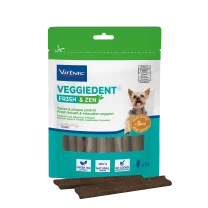
Our VeggieDent ZEN dental chews combine dental chewing with green tea extract to support relaxation. They should be seen as a dual-purpose daily chew though, not as a treatment for anxiety.
VeggieDent Dental Chews
-
308303_Packshot_Veggiedent-Zen_XS_New_face.png 
GB_New-Veggiedent-ZEN_Unity-visual_1a_2026.jpg VeggieDent® FR3SH & ZEN Dental Chews – Calming Treats for Dogs
XS - Small dog - Medium dog - Large dog
From £8.25Details on VeggieDent® FR3SH & ZEN Dental Chews – Calming Treats for Dogs

How often should dogs have dental chews?
How often your dog should have a chew depends on the individual product. Always follow the pack instructions rather than applying one rule to every brand.
VeggieDent FR3SH and VeggieDent ZEN are designed for daily use according to their directions. Consistency is important because plaque reforms continuously.
Remember to:
- follow the label
- use the correct size
- include the chew’s calories in your dog’s daily allowance
A dental chew should support your dog’s wider healthcare routine, not be treated as a one-off solution.
Why brushing your dog’s teeth is still important
Brushing remains the foundation of at-home plaque control. Even the best chew won’t contact every tooth surface evenly or clean beneath the gumline.
Brushing lets you target the outer tooth surfaces and gumline, where plaque commonly accumulates. Be sure to use toothpaste made for pets, not human toothpaste.
Our C.E.T. Enzymatic Toothpaste contains glucose oxidase and lactoperoxidase as part of Virbac’s Dual Enzyme System. This helps support bacterial control alongside the physical cleaning provided by brushing.
Meanwhile our Dual-Ended Toothbrush has two head sizes, soft bristles, reverse-angled heads and a long handle for control and access. These features can make it easier to reach different areas of your dog’s mouth comfortably.
Introduce brushing gradually. Let your dog taste the toothpaste first, keep early sessions short and use praise to build a positive routine. Our guide on how to clean your dog’s teeth provides more detailed advice on brushing if you need it.
Building a complete dental care routine
A good dog oral hygiene routine can include four key things.
- Brush regularly with a pet-specific toothbrush and toothpaste
- Give an appropriately sized dental chew according to the instructions
- Use an oral rinse when additional support is appropriate
- Arrange regular veterinary dental checks
Our Hexarinse oral rinse helps control the bacteria that contribute to plaque, bad breath and minor gum irritation. It contains chlorhexidine gluconate (0.12%), a widely used oral care ingredient, and can be applied along the teeth and gumline as extra support alongside brushing. Use it as directed on the product or by your vet.
A daily VeggieDent FR3SH chew can then add mechanical cleaning between brushing. The right combination will depend on your dog’s tolerance, current oral health and individual needs.
When should you speak to your vet about your dog’s teeth?
Homecare helps reduce new build-up, but it can’t reverse established dental disease.
Speak to your vet if your dog has:
- painful or reluctant chewing
- bleeding gums
- loose or damaged teeth
- facial swelling
- marked difficulty eating
- persistent, severe bad breath
- vomiting or distress after swallowing a chew
Gingivitis means inflammation of the gums. Periodontitis is a more advanced disease affecting the tissues that support the teeth. Firmly attached tartar and periodontal disease may require further expert advice and professional treatment.
Support your dog's oral health every day
The right dental chew can make a useful contribution to daily plaque and tartar control. Look for veterinary-backed evidence, choose the correct size and use every chew safely and consistently.
Most importantly, treat chews as one part of your daily routine. Brushing, suitable dental products and regular vet check-ups all play a part.
You can explore our dog dental-care range to browse our selection of chews, toothpaste, toothbrushes and oral-hygiene support designed for everyday care.
FAQs about dog dental chews
Are dental chews good for dogs?
The right dental chews can be good for dogs. An appropriately sized, evidence-supported product like Virbac’s VeggieDent chews can help reduce new plaque or tartar accumulation. However, product quality varies, and dental chews don’t replace brushing or veterinary dental care.
How often should dogs have dental chews?
Follow the directions for the individual product. Some dental chews, including our VeggieDent FR3SH and VeggieDent ZEN chews, are designed for daily use. Remember to include the calories within your dog’s daily food allowance.
What is the best dental chew for dogs in the UK?
Look for vet-backed products like Virbac’s VeggieDent chews if you’re looking for the best dental chew for your dog. Choose a product that’s correctly sized, safe for your pet’s chewing style, compatible with their diet and supported by scientific evidence. VOHC Acceptance is also something to look for when claims are made about specific products.
Can dental chews replace brushing?
No. Dental chews don’t reach every tooth surface or clean below the gumline. They work best as an addition to brushing with pet-specific toothpaste and regular veterinary dental checks.
Are dental chews safe for puppies?
It depends on the product’s minimum age guidance, your puppy’s size, chewing behaviour and dental development. Check the label, supervise every chew and ask your vet if your puppy has dental, digestive or dietary needs.